
Before 9 AM: The 5 Signals That Tell You If Today’s Plan Is Already at Risk
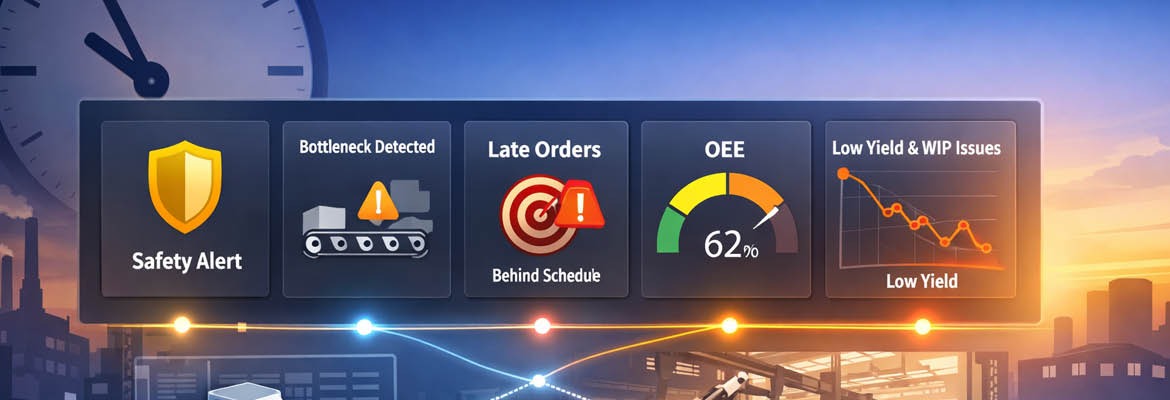
Experienced plant managers don’t need KPI definitions. You know OEE. You know FPY. You know downtime.
The real question before 9 AM is: If nothing changes, where will we lose the day?
The first hour isn’t for reporting. It’s for deciding.
These seven signals aren’t metrics. They’re triggers.
And they only work if the systems behind them are credible.
1) Safety: Does Anything Change How We Run Today?
Not recordables — operating risk.
- Did anything happen that alters how we run this line?
- Are we operating under a temporary workaround?
- Are open corrective actions tied to today’s production?
Temporary deviations become permanent when standard work isn’t visible and enforced.
Plants that digitize and control standard work execution — rather than relying on tribal knowledge — reduce drift between “how it should run” and “how it’s actually running.”
Trigger: What changes in the next hour to reduce risk?
(PINpoint’s real-time visibility and standard enforcement make safety-related deviations visible immediately — not after the shift.)
2) The Constraint: What Governs Throughput Right Now?
If you don’t identify the constraint early, it will identify itself later.
- Which asset or process sets the pace?
- Is it stable?
- Is it drifting (cycle time, micro-stops, skill gaps)?
But here’s the uncomfortable truth:
If your routings are inflated or work content is uneven, you don’t actually know your constraint.
Planning integrity determines whether the “constraint” on paper matches the one on the floor.
Then, on the floor, you need live performance visibility to catch drift before it becomes downtime — where PINpoint supports early intervention.
Trigger: What stabilizes the constraint in the next 30–60 minutes?
Boosting Production with PINpoint
3) Plan Attainment: Are We Protecting What Must Ship?
Output vs. plan only matters if capacity assumptions are accurate.
- What absolutely must ship today?
- Did variance begin early?
- Are we protecting priority orders?
Morning attainment debates usually trace back to one issue: the plan was never feasible.
When labor standards and cycle times are engineered correctly in Proplanner, attainment becomes an execution signal — not an argument about what was “supposed” to happen.
Execution discipline on the floor — reinforced through real-time feedback loops in PINpoint — ensures the plan is actually being run as designed.
Trigger: Are we defending the right work — or defending a flawed assumption?
4) OEE: Which Lever Is Moving — and Which Are We Ignoring?
Don’t stare at the score. Decompose it.
- Availability
- Performance
- Quality
You cannot recover all three in one shift.
But you also can’t improve what you can’t see in real time.
OEE reported after the shift is history.
OEE monitored live — at the point of execution — allows mid-shift correction.
PINpoint’s real-time production visibility surfaces performance and quality drift before it compounds.
And when performance standards are engineered accurately upstream in Proplanner, you know what “good” actually looks like.
Trigger: Which lever are we deliberately choosing to fix today?
5) Yield & Flow Stability: Are We Creating Hidden Capacity Loss?
Early FPY drift and unstable WIP are not separate problems.
They are signals that the system is losing control.
If yield drops at 8:30 AM and production continues unchanged, you are choosing to build a hidden factory — one that consumes capacity later through rework, sorting, and expediting.
At the same time, WIP tells you whether that instability is contained or spreading.
- Where is the first failing step?
- Is suspect WIP contained?
- Is the constraint starved or blocked?
- Are holds aging?
Too little WIP at the constraint signals starvation.
Too much signals blockage.
Growing rework queues signal compounding loss.
Healthy systems maintain controlled tension — not excess inventory, not firefighting.
Most repeat defects don’t stem from lack of analysis.
They stem from inconsistent execution of standard work.
Upstream, engineered time standards and clear work definitions (Proplanner) establish what “right” looks like.
On the floor, real-time process visibility and enforcement (PINpoint) prevent drift before it scales.
Without planning integrity, buffers become unpredictable.
Without execution visibility, variation compounds.
Trigger: What do we stop, quarantine, or clear right now to protect flow at the constraint?
What Happens When All Signals Live in One View?
Today, most plants piece these signals together across systems, spreadsheets, whiteboards, and conversations. Soon, that changes. Advantive ONE — our upcoming unified platform — is designed to bring engineered standards (Proplanner), real-time execution visibility (PINpoint), and operational performance data into a single connected environment. Instead of toggling between tools to understand risk, leaders will see these signals in context — where planning assumptions diverge from execution, where constraints are drifting, where yield risk is forming, and where flow is destabilizing. This isn’t about adding another dashboard. It’s about surfacing decision-ready intelligence before 9 AM — so faster, more strategic decisions happen before the day is lost.
- Honest conversation with a product expert
- Discover what products or solutions best fit your needs
- No games, gimmicks, or high-pressure sales pitch
Sharon DiRe
About the Author Latest Posts
- What Manufacturing Leaders Should Actually Expect from AI in 2026 May 5, 2026
- Throughput vs. Waste Is a False Tradeoff in Packaging Operations April 23, 2026
- Packaging Performance Doesn’t Break on the Line. It Breaks in Your Operating Model April 21, 2026
- Why Manufacturing Still Feels Reactive After Digital Transformation April 7, 2026
- AI in Packaging: Why Most Initiatives Stall Without Real-Time Plant-Floor Visibility April 2, 2026
Reviewed by
Manufacturing operations review panel
Content on MES, manufacturing execution, traceability, and process planning is reviewed by the ProPlanner, PINpoint, ParityFactory, VIA Information Tools, and ComSense teams — covering discrete manufacturing, automotive tiered supply, and food-and-beverage traceability.