
Corrugator Scheduling: The Hidden Profit Lever in Corrugated
Many improvement efforts in the corrugated packaging environment focus on what’s visible – machine uptime, waste reduction, labor efficiency, and throughput. These are measurable, tangible, and operationally familiar.
However, one of the most powerful profit levers in the plant isn’t on the floor, but in the schedule.
And in today’s environment, the gap between average and high-performing plants is increasingly defined by how intelligently that schedule is built (and rebuilt) in real time.
Scheduling Is Driving More Than You Think
Every plant runs on a schedule. Orders are sequenced, machines are loaded, and production moves forward, but the assumption that “a schedule exists, therefore we’re optimized” is where margin quietly erodes.
Because scheduling decisions directly influence:
- Corrugator run efficiency (paper changes, flute sequencing, speeds)
- Converting line utilization and setup frequency
- Labor stability and overtime exposure
- Waste generation from suboptimal transitions
- On-time delivery performance
These aren’t isolated outcomes. They compound over a period of time.
A poorly sequenced day at the corrugator doesn’t just reduce throughput. It ripples into converting delays, increased handling, and reactive firefighting across the plant.
Many operations feel these effects. Few quantify them.
Why Traditional Scheduling Is Breaking Down
For decades, scheduling has been a planner-driven function built on experience, tribal knowledge, and static tools. And historically, that worked.
But the operating environment has changed.
- Shorter runs, more SKUs: Increased order variability disrupts traditional run strategies
- Faster turnaround expectations: E-commerce and retail demand tighter windows
- Labor constraints: Less experienced planners and operators increase variability
- More frequent disruptions: Material changes, machine issues, and last-minute orders
The result? Scheduling has become too complex to manage effectively with spreadsheets or static logic.
What used to be a daily planning exercise is now a continuous optimization problem.
The Hidden Cost of “Good Enough” Scheduling
Many plants operate with schedules that are “good enough” to ship product.
But “good enough” often includes:
- Excessive changeovers that reduce available capacity
- Inefficient corrugator sequencing that increases waste
- Misalignment between corrugator output and converting readiness
- Frequent expedites that override planned efficiency
- Idle time masked by reactive adjustments
Individually, these issues are manageable. Collectively, they represent a significant (and often invisible) profit drain.
In a margin-sensitive industry, even small percentage improvements in these areas translate into meaningful financial impact.
Scheduling as a Real-Time Control System
High-performing plants are starting to treat scheduling differently—not as a static plan, but as a real-time control system for the operation.
This shift is driven by two key capabilities:
- Live visibility into plant conditions
- The ability to dynamically adjust the schedule based on those conditions
Instead of asking, “What should we run today?” leading operations are asking:
- What is the optimal sequence right now, given current constraints?
- How do we minimize total changeover impact across corrugating and converting?
- What is the cost of inserting an expedite—and is it justified?
- How do we rebalance the schedule when reality deviates from plan?
This is where scheduling moves from coordination to optimization.
Where AI Is Changing the Equation
The next evolution in corrugated scheduling is being driven by AI and advanced optimization models.
Not in a theoretical sense but in practical, plant-level applications.
AI-enabled scheduling systems can:
- Evaluate thousands of sequencing scenarios in seconds
- Balance competing constraints (machine capability, order priority, material availability)
- Continuously learn from actual production outcomes
- Recommend or automatically adjust schedules as conditions change
For example:
- Grouping orders to minimize flute and paper changes while still meeting delivery commitments
- Synchronizing corrugator output with converting capacity to avoid bottlenecks
- Identifying when a “rush order” will create more downstream cost than value
- Adapting schedules mid-shift based on machine performance or downtime
This is about augmenting decision-making with data and speed that manual processes can’t match.
The Power of Connected Scheduling
AI-driven scheduling is only as effective as the data it can access, so the real opportunity emerges when scheduling is connected across the operation.
When scheduling is integrated with:
- Real-time production data
- ERP order management
- Inventory and material availability
- Machine performance and constraints
…it becomes significantly more powerful.
This’s where Advantive ONE, together with Kiwiplan, changes how scheduling decisions are made.
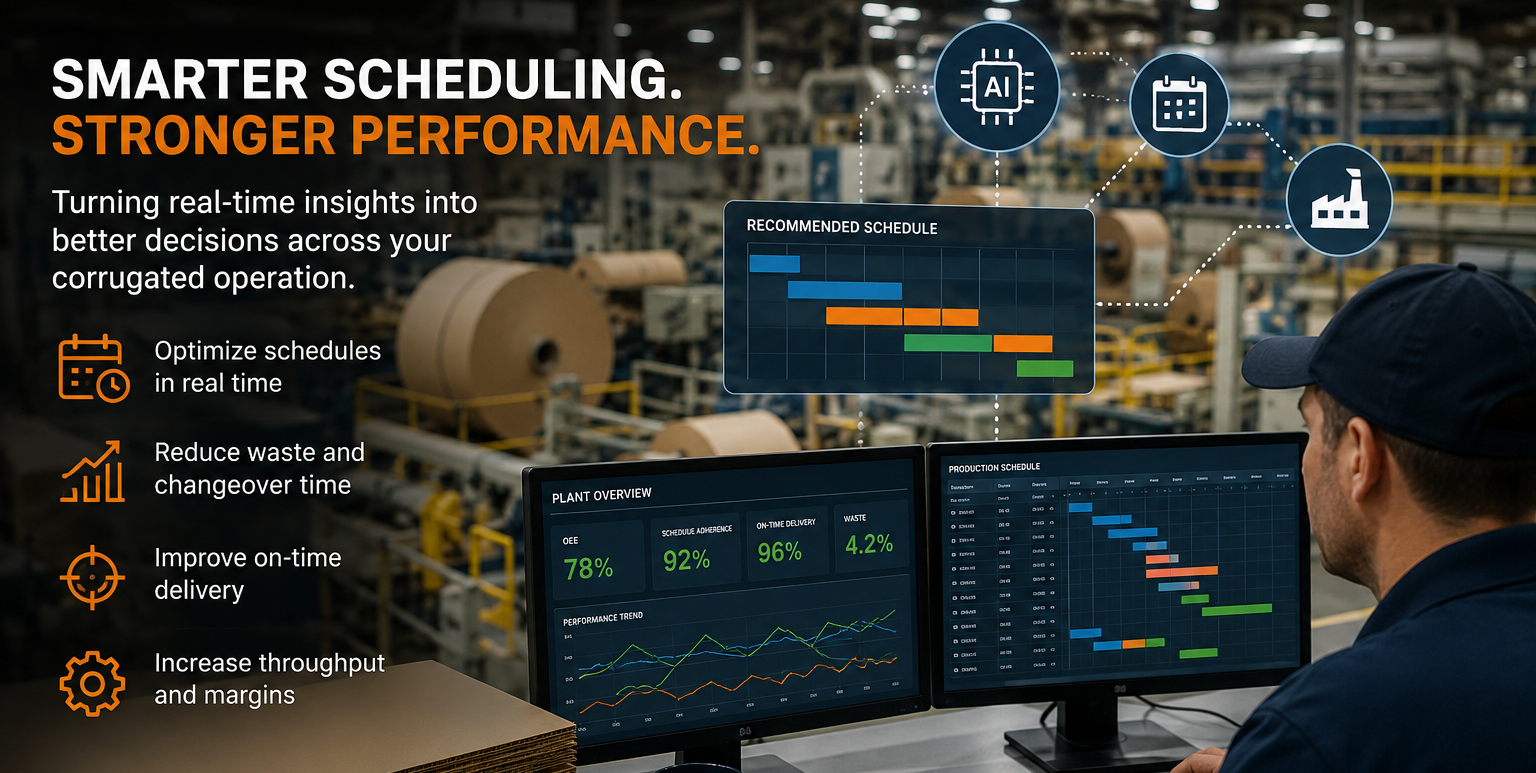
Advantive ONE brings AI-powered intelligence directly into the day-to-day flow of plant operations, turning production data into real-time answers, context, and guidance for scheduling and execution. Instead of relying on disconnected reports or manually piecing together plant conditions, teams can interact with their operation in a more direct and immediate way.
That means you can:
- Understand how corrugator performance, order sequencing, and converting readiness are interacting in real time
- Identify emerging schedule risks – such as downtime, bottlenecks, or misaligned runs –before they impact output
- Get immediate insight into why a schedule is slipping or where inefficiencies are being introduced
- Make faster adjustments with a clearer view of trade-offs across waste, throughput, and delivery
Kiwiplan provides the operational depth – 24/7 automated corrugator scheduling, plant visibility, and production intelligence that reflects the realities of corrugated manufacturing.
Advantive ONE builds on that by making this intelligence more accessible and actionable within the flow of work.
Rather than navigating multiple systems or waiting on reports, planners and plant leaders can engage directly with scheduling performance by asking questions, surfacing issues, and making decisions with real-time clarity.
In this connected environment, scheduling becomes a continuously informed, actively managed part of the operation aligned with what’s happening on the floor and responsive to what happens next.
What This Means for Plant Leaders
For plant managers and operational leaders, the implication is clear:
You need to unlock more value from the schedule you already run every day.
Practical starting points include:
- Quantify the impact: Measure changeover time, sequencing efficiency, and schedule adherence
- Identify disconnects: Where does the plan diverge most from actual production?
- Evaluate tools: Are planners equipped with real-time data and scenario modeling capabilities?
- Align operations: Ensure corrugator and converting strategies are coordinated, not competing
- Explore AI readiness: Do you have the data foundation to support advanced scheduling?
These steps don’t require immediate transformation, but they do require a shift in mindset.
A Lever Hiding in Plain Sight—Now Within Reach
In an industry defined by physical assets, it’s easy to focus on what can be seen: machines, materials, and labor. But increasingly, competitive advantage is driven by how intelligently those assets are orchestrated.
Scheduling sits at the center of that.
And with the emergence of connected systems and AI-driven optimization, it is no longer an overlooked function. It is a scalable, measurable, and accessible profit lever. The difference now is that it can be managed with the same precision and visibility as the rest of the operation and turn daily decisions into sustained performance.
Grace Barton
Marketing Specialist
About the Author Latest Posts
Grace Barton is a digital marketing and competitive intelligence professional who crafts strategic narratives by bridging marketing insights with analytical expertise. At Advantive, she creates engaging, data-driven content tailored to the distribution, manufacturing, packaging, and quality industries. Her goal is to deliver impactful messaging that drives engagement and growth based on specific gap closure needs, whether responding to sales organization requirements, pinpointing gaps in content, or meeting immediate market trends.
She thrives on transforming competitive intelligence into actionable insights for the sales organization. Grace manages Advantive’s competitive intelligence platform, Klue, to equip the sales team with the battlecards and market data they need to stay ahead of competitors. Since launch, she’s built 28+ battlecards across four lines of business, ensuring the GTM strategy stays sharp.
Grace has a passion for leveraging market insights with storytelling to guide strategic decision-making, empower sales organizations, and nurture organizational growth.
Areas of Expertise: Digital Marketing, Competitive Intelligence, Strategic Narratives, Marketing Insights, Analytical Expertise
- Why Scheduling is Still the Hidden Lever in Corrugated Packaging May 14, 2026
- From Data to Decisions: What AI Could Unlock Inside Your ERP April 30, 2026
- From Data to Direction: Why Advantive ONE Signals a New Era of Industrial AI April 14, 2026
- When the Warehouse Becomes the Bottleneck April 9, 2026
- The Power of Virtual Assistants When They’re Built for Real Work February 3, 2026
Reviewed by
Packaging operations review panel
Content on corrugator scheduling, packaging ERP, and converter operations is reviewed by the KiwiPlan, Abaca, and AdvantZware product teams, who build software specifically for corrugated, folding-carton, and packaging converters.