
The Modern Assembly Line and Quality Management: 100 Years Later
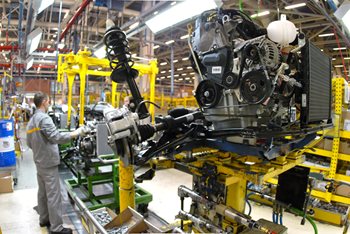
It has been just over 100 years since Henry Ford introduced the modern assembly line and forever changed the course of manufacturing. The combination of interchangeable parts and time-efficient processes created a system that eventually sold 15 million Model T Fords and made the automobile one of the centerpieces of American culture.
Over a century later, the modern assembly line is still the main arm of the global manufacturing industry. Ford’s model has withstood the test of time and is still proving to be an efficient process. But it’s not done evolving yet.
Quality Manufacturing = Quality Products
Today, there are still many challenges facing manufacturing executives as they work to optimize the assembly line. The majority of these problems center on the speed and accuracy of production. Manufacturing facilities need to create quality products, and they need to do so in a time- and cost-efficient manner. In order to keep the manufacturing process strong, executives must constantly innovate to reduce waste, speed up automated processes, and ensure that enterprise quality management remains unhindered. With the cost of poor quality so high today, companies have so much to gain by investing in and prioritizing assembly line quality assurance.
Statistical Process Control Software Meets Modern Needs
Most crucial to effective enterprise and modern assembly line quality control is the ability to receive instant feedback on automated processes. Manufacturing executives cannot wait until a product is packaged and sent out to vendors in order to realize that the quality does not conform to expected standards. Now, using statistical process control (SPC) software, assembly line processes can be adjusted in a timely fashion as soon as product variation is detected, preventing future recalls, customer complaints, and other unforeseen issues in the field.
Aside from the necessity of instant feedback, a modern-day assembly line requires technology to meet the demands of an ever-growing mobile workforce. Manufacturing executives are constantly on the go, and need access to real-time data no matter where they are. Whether they are at a conference in Beijing or a manufacturing facility in Chicago, there is no time for latency when it comes to receiving feedback from the production line and across the enterprise. With access to SPC software via the cloud, executives can receive streamlined information directly to mobile devices such as cell phones, tablets and more. This way, important decisions can be made using quality metrics in real time.
On a modern assembly line, the quality of data gathered is more valuable than the quantity. It’s not enough for machines to simply measure processes and collect metrics. Metrics do not have any value unless they are usable by manufacturers—and this is a crucial step in the process. Assembly line quality assurance requires software that can collect quality data and transform it into usable information, working to ensure product quality during an automated process—instead of finding out about an error after it is done.
Quality Intelligence for Enterprise Quality Management
Using quality intelligence software, manufacturers can easily generate usable information from the assembly line that enacts company-wide transformation. By unifying and analyzing real-time data, collected from multiple sources across the organization, in a centralized quality hub, manufacturers can create greater real-time visibility across assembly lines enterprise wide and make informed decisions about their product quality and processes.
Henry Ford’s assembly line used innovation to bring about change in the global manufacturing industry. If the industry wants to remain a competitive force over the next century, the success of the modern assembly line will depend heavily on manufacturers’ ability to innovate. Quality management innovation can support a manufacturer’s overall sustainability, through preventing errors, improving processes, reducing waste, and offering a competitive edge in the industry.
For more information on how InfinityQS software can provide quality innovation in your manufacturing facility and throughout your enterprise, please click here. Or, to learn more about how quality intelligence solutions can transform manufacturing, please read the InfinityQS white paper “Enact: The Future of Quality.”
Grace Barton
Marketing Specialist
About the Author Latest Posts
Grace Barton is a digital marketing and competitive intelligence professional who crafts strategic narratives by bridging marketing insights with analytical expertise. At Advantive, she creates engaging, data-driven content tailored to the distribution, manufacturing, packaging, and quality industries. Her goal is to deliver impactful messaging that drives engagement and growth based on specific gap closure needs, whether responding to sales organization requirements, pinpointing gaps in content, or meeting immediate market trends.
She thrives on transforming competitive intelligence into actionable insights for the sales organization. Grace manages Advantive’s competitive intelligence platform, Klue, to equip the sales team with the battlecards and market data they need to stay ahead of competitors. Since launch, she’s built 28+ battlecards across four lines of business, ensuring the GTM strategy stays sharp.
Grace has a passion for leveraging market insights with storytelling to guide strategic decision-making, empower sales organizations, and nurture organizational growth.
Areas of Expertise: Digital Marketing, Competitive Intelligence, Strategic Narratives, Marketing Insights, Analytical Expertise
- Why Scheduling is Still the Hidden Lever in Corrugated Packaging May 14, 2026
- From Data to Decisions: What AI Could Unlock Inside Your ERP April 30, 2026
- From Data to Direction: Why Advantive ONE Signals a New Era of Industrial AI April 14, 2026
- When the Warehouse Becomes the Bottleneck April 9, 2026
- The Power of Virtual Assistants When They’re Built for Real Work February 3, 2026