
Proplanner’s eKitting Module Generates Pick Lists and Tracks Carts
eKitting
Generate pick lists and track and manage kit carts and sequenced items for specific units and batches on the line.
Automatic Generation and Sequencing of Configured Kits
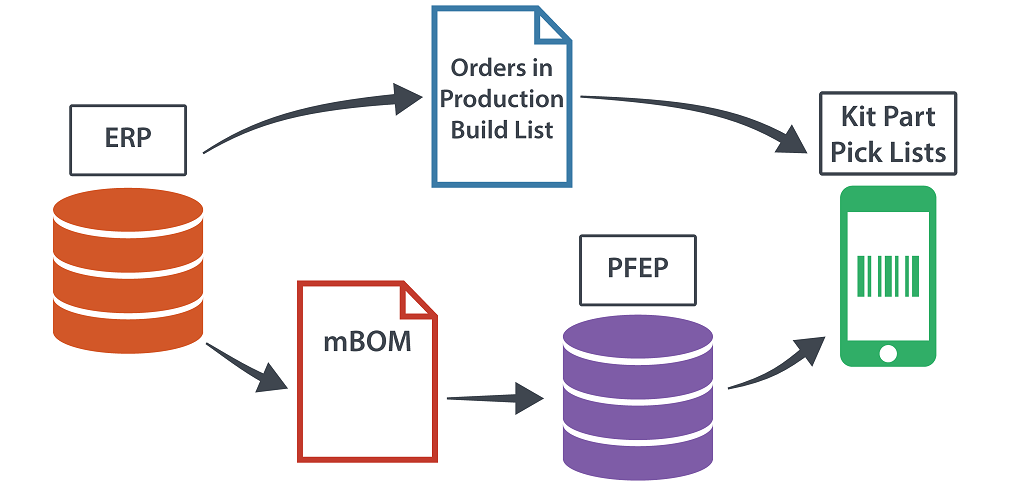
Based on the ERP mBOM for each unit and the Plan For Every Part data, the list and quantity of required parts are generated automatically. The more complex the product and more varied the customer order, the more challenging kit generation is, which is why Proplanner’s automatic generation based on the mBOM, process, and logistics planning data available is so valuable.
The kits are sequenced so that picking can be performed based on the sequence of units on the line. Kit data can also be sent directly to a warehouse management system.
Part Picking Validation
By using handheld scanners, kit pickers are guided to the location of each part and scan part location barcodes to ensure that each kit is built correctly. This significantly improves the accuracy of the parts delivered to the line and reduces the lineside inventory required.
Part pickers can mark parts as skipped in the case of a missing or damaged part so that the kit proceeds through its cycle when necessary, but it is tagged as an incomplete kit on the status dashboards and to any operator working on the unit the kit belongs to.
Live Part Status Dashboards
Live Dashboards convey the status of each kit and each unit on the line to assembly, logistics, and warehouse teams. The increased visibility allows for greater reaction time in the case of missing, damaged, or otherwise unavailable parts to reduce overall part shortages at the line.
Hot Calls from the Line
If a kit is delivered to the line with a skipped or a missing part and is not received by the time the operator starts work on the corresponding unit, the operator can file a “hot call” for the part through their work instruction on Proplanner’s Shop Floor Viewer. This triggers a kanban card to be printed for that part in the supermarket, warehouse, or external vendor, so that the part can be delivered quickly through a kanban cycle. Through the live dashboards, the operator can track the status of the kanban delivery.
Why is Proplanner’s eKitting solution more effective than ERP’s kitting tools?
- Engineering changes and line re-balances can be phased in accurately with the use of date and unit serial-based effectivity filtering.
- Kits can be picked for single or multiple units.
- Kits for single units can travel and be tracked with the unit down the line.
- Part picking can be triggered in the supermarket rather than by a pull system from the line.
- Transaction data can be leveraged with material flow analysis tools.
- The grid interface feels and functions like Excel for editing.
Why not continue using Excel to plan for and manage kit deliveries?
Manual planning by one user at a time of all kitted parts and their delivery timing, with no integration to ECOs and mBOMs, simply leads to too many errors on the floor.
Assembly Planner integrates process planning data with the mBOM and build list to implement effective kit generation and delivery:
- Automatic generation of the picklist for each kit.
- Verification scans of each part picked.
- Progress scans indicate the status of the kit.
- Multiple kitting strategies supported.
- Hot calls automatically trigger requests to the part’s source.
- Live status dashboards give all teams visibility into parts or kits that may cause issues.
Grace Barton
Marketing Specialist
About the Author Latest Posts
Grace Barton is a digital marketing and competitive intelligence professional who crafts strategic narratives by bridging marketing insights with analytical expertise. At Advantive, she creates engaging, data-driven content tailored to the distribution, manufacturing, packaging, and quality industries. Her goal is to deliver impactful messaging that drives engagement and growth based on specific gap closure needs, whether responding to sales organization requirements, pinpointing gaps in content, or meeting immediate market trends.
She thrives on transforming competitive intelligence into actionable insights for the sales organization. Grace manages Advantive’s competitive intelligence platform, Klue, to equip the sales team with the battlecards and market data they need to stay ahead of competitors. Since launch, she’s built 28+ battlecards across four lines of business, ensuring the GTM strategy stays sharp.
Grace has a passion for leveraging market insights with storytelling to guide strategic decision-making, empower sales organizations, and nurture organizational growth.
Areas of Expertise: Digital Marketing, Competitive Intelligence, Strategic Narratives, Marketing Insights, Analytical Expertise
- Why Scheduling is Still the Hidden Lever in Corrugated Packaging May 14, 2026
- From Data to Decisions: What AI Could Unlock Inside Your ERP April 30, 2026
- From Data to Direction: Why Advantive ONE Signals a New Era of Industrial AI April 14, 2026
- When the Warehouse Becomes the Bottleneck April 9, 2026
- The Power of Virtual Assistants When They’re Built for Real Work February 3, 2026